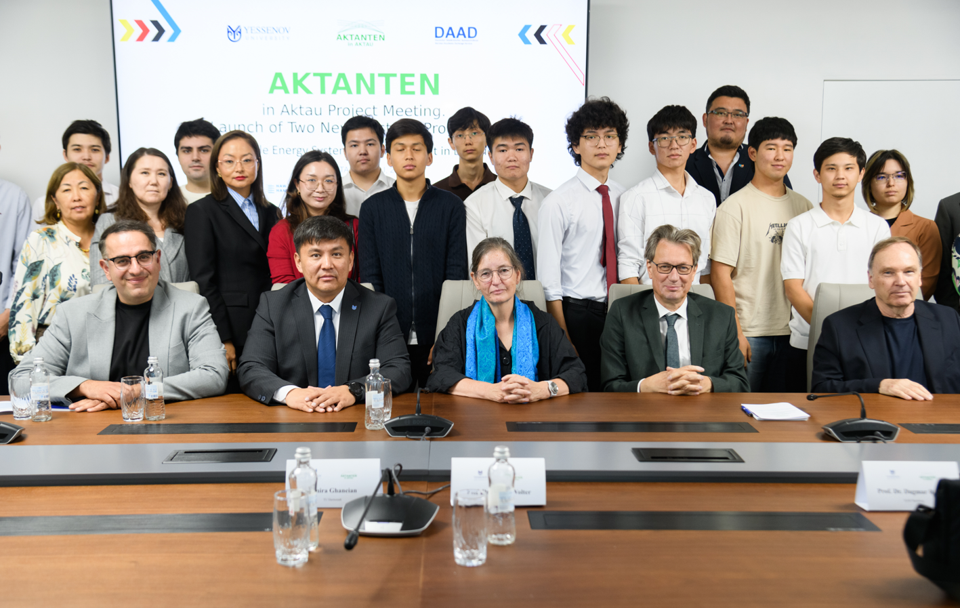
On September 14, 2026, a ceremonial launch of the AKTANTEN project was held in Aktau. As part of the project, master’s-level education began under educational programs at the Kazakh-German Institute of Sustainable Engineering (KINI) in Aktau and at the Kazakh-German University (DKU) in Almaty.
The AKTANTEN project was initiated and developed with the direct involvement of DKU in cooperation with German and Kazakh partners. It is being implemented with the support of the DAAD and is aimed at developing master’s programs in the fields of energy and logistics, as well as expanding scientific and academic cooperation among DKU, KINI, Yessenov University, and leading universities in Germany. The German project partners include Hamburg University of Applied Sciences, Technische Universität Berlin, Technische Universität Darmstadt, and Technische Hochschule Wildau.
The ceremonial launch of the project in Aktau was attended by DKU President Professor Dr. Wolrad Rommel and DKU Vice President for International Relations Dr. Askhat Zhilkaidarov.
In 2026, 16 master’s students were admitted to the “Logistics” master’s program at DKU as part of the AKTANTEN project.
One of the key features of the project is its international teaching staff. Professors, lecturers, and experts from Kazakhstan and Germany are involved in delivering the educational programs. This makes it possible to combine the academic and practical experience of the two countries, integrate modern approaches in the fields of energy and logistics, and provide master’s students with knowledge and competencies that meet the requirements of the international professional environment.
Academic mobility is an important component of AKTANTEN. The project’s top-performing master’s students will have the opportunity to spend one semester at a German partner university, continue their studies in an international academic environment, and gain direct access to Germany’s educational and research landscape.
For DKU, participation in the project means not only the development of its master’s programs, but also further strengthening the university’s role as an academic bridge between Kazakhstan and Germany, bringing together students, faculty members, researchers, and partner organizations from the two countries.